

When Your Child Can’t Switch Off: The Hidden Power of Your Own Nervous System
Why the answer to your child’s fight or flight might not be what you think
The phone call that changed everything
Last week, a mum rang me about her daughter who couldn’t seem to switch off that constant fight or flight state. You know the one, where your kid’s always on edge, struggling to think clearly, learn properly, or feel good about themselves. It’s heartbreaking to watch, isn’t it?
She asked where to start, and I had to pause. Because what I wanted to tell her wasn’t what most people expect to hear.
The answer wasn’t another therapy appointment or specialist treatment (though these can be brilliant when needed). The answer was sitting right there in her lounge room, looking back at her in the mirror.
Understanding the nervous system: your child’s internal security system
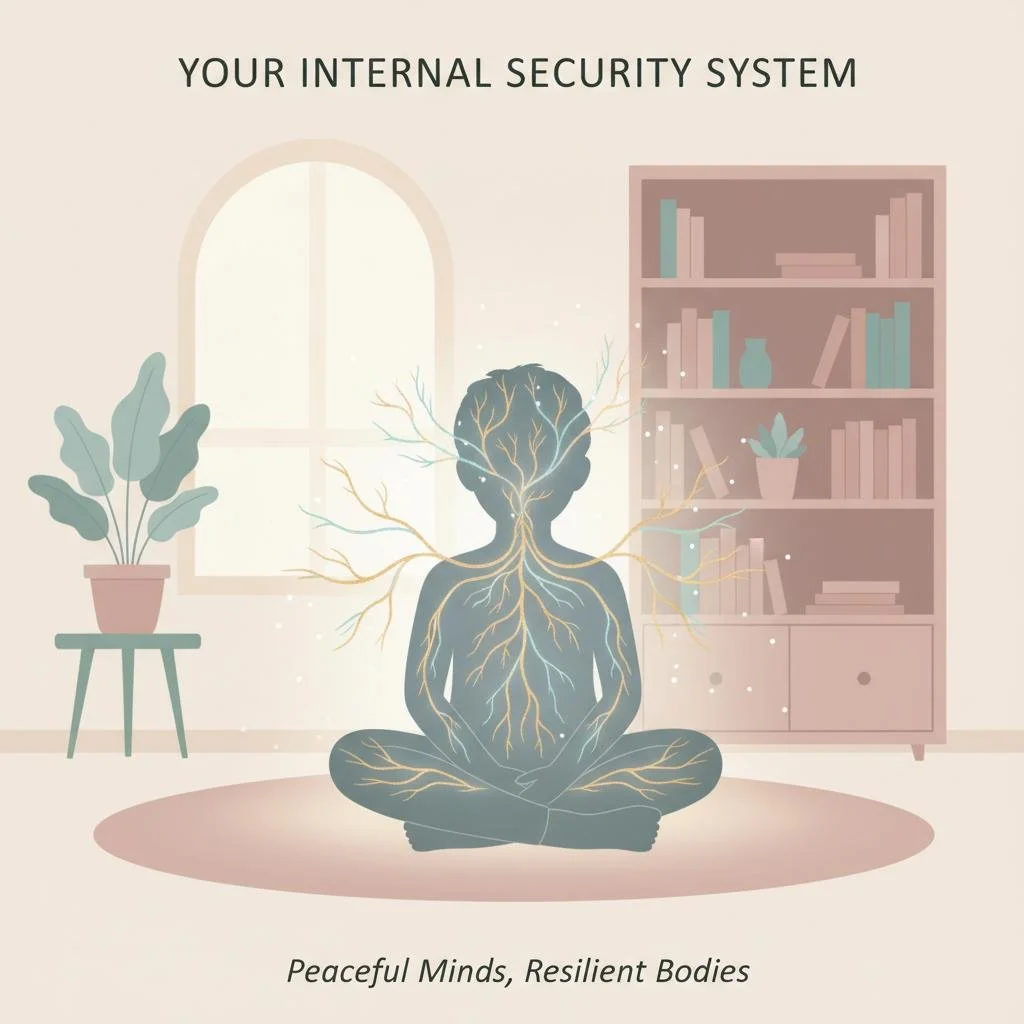
Before we dive deep, let’s get our heads around what we’re actually dealing with. Your child’s nervous system is essentially their body’s security system, constantly scanning the environment for safety or threat. When it perceives danger, real or imagined, it activates what we know as the fight or flight response.
This system evolved to keep us alive when faced with genuine physical threats like predators. But here’s the kicker, your child’s nervous system can’t distinguish between a real tiger and the “tiger” of everyday stress, school pressure, family tension, overstimulation, or even just the general pace of modern life.
When children get stuck in this hypervigilant state, their bodies are essentially saying, “The world isn’t safe, so I need to stay alert and ready to run or fight at all times.” This chronic activation affects everything, their ability to learn, sleep, regulate emotions, form relationships, and develop a healthy sense of self.
The invisible force shaping your child’s nervous system
Here’s the thing that blew my mind when I first discovered it, our kids’ nervous systems are like little radio receivers, constantly tuning into the emotional frequency of their environment. And the strongest signal they’re picking up is ours.
Bruce Lipton’s groundbreaking research in epigenetics shows us something profound. It’s not just what’s happening inside our children that matters, but the environment around them that literally tells their cells whether it’s safe to thrive or whether they need to stay in survival mode.
At the cellular level, chronic stress triggers the release of stress hormones like cortisol and adrenaline. When these hormones are constantly elevated, they actually change gene expression, affecting everything from immune function to brain development. But, and this is the hopeful bit, when children feel genuinely safe and supported, their bodies can shift into what researchers call the “growth and repair” mode, where healing, learning, and development can flourish.
Think about it, if your child’s world feels safe, warm, and connected, their nervous system gets the message that it’s okay to relax, learn, and grow. But if there’s stress, unpredictability, or even just the background hum of busy family life, their body can stay stuck in that hypervigilant state.
The science of co-regulation: why your calm matters more than you think
This is where it gets really fascinating (and a bit confronting, if I’m honest). There’s something called the law of entrainment. Our children’s nervous systems are literally wired to sync up with ours. This isn’t just feel-good psychology, it’s measurable neuroscience.
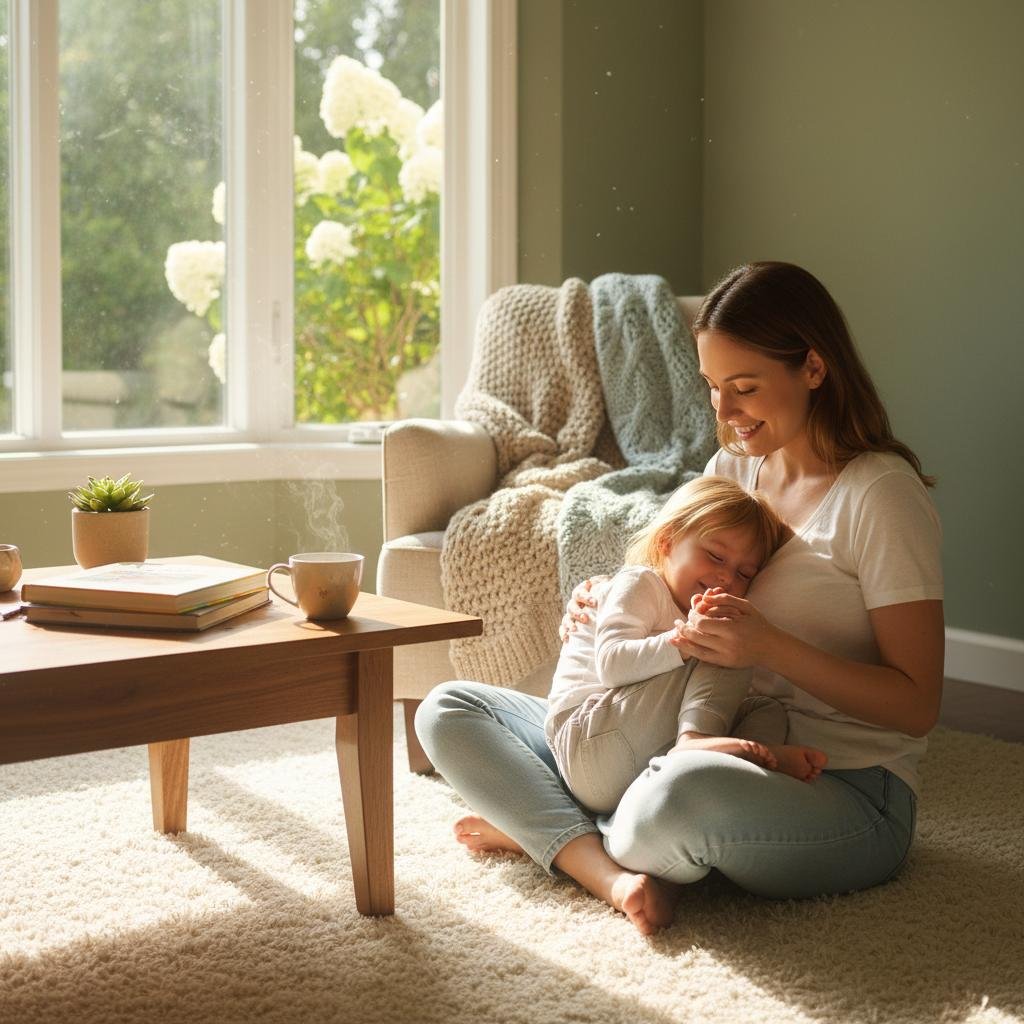
Research from the field of interpersonal neurobiology shows us that when two nervous systems come into contact, they influence each other. The more regulated nervous system tends to “pull” the dysregulated one towards greater stability. This is called co-regulation, and it’s the foundation of emotional development in children.
Here’s what this looks like in real terms. When you’re in a calm, regulated state, your child’s mirror neurons are picking up on your facial expressions, tone of voice, body language, and even your breathing patterns. Their nervous system begins to match yours, literally learning regulation through proximity to your calmness.
But the opposite is also true. If we’re often anxious, tense, or running on empty (and let’s face it, who isn’t these days?), our kids will mirror that without even realising it. They’re not choosing to be dysregulated; they’re responding to the nervous system information we’re unconsciously broadcasting.
The polyvagal theory: understanding the three states
Dr Stephen Porges’ polyvagal theory gives us an even deeper understanding of what’s happening. According to this research, our autonomic nervous system has three main states.
Social Engagement (Ventral Vagal): This is our optimal state, calm, connected, curious, and creative. When children are in this state, they can learn, play, and form healthy relationships.
Fight or Flight (Sympathetic): This is the mobilised stress response. Children in this state might be hyperactive, aggressive, anxious, or oppositional.
Shutdown (Dorsal Vagal): This is the collapse response when fight or flight becomes unsustainable. Children might seem withdrawn, depressed, or completely disconnected.
The goal isn’t to eliminate all stress responses, they’re natural and sometimes necessary, but to help children develop the capacity to return to social engagement relatively quickly after a stressful event.
My own rude awakening: when I realised I was part of the problem
I learnt this the hard way with my four kids. For ages, I was frantically trying to fix their big emotions, their meltdowns, their inability to settle. I was the mum researching every possible intervention, booking appointments, buying books, trying every technique under the sun.
What I didn’t realise was that I was unknowingly contributing to the very stress I was trying to help them overcome. My rushing energy, my constant worry about them, my own dysregulated nervous system, it was all being absorbed by their sensitive little systems.
I was stuck in what I now recognise as the “fixing” mindset, believing that if I could just find the right technique, therapy, or intervention, I could solve their problems. But what I was missing was the most fundamental piece of the puzzle, my own nervous system state.
The day I finally understood this was the day everything shifted. Not immediately (because real life isn’t a fairy tale), but profoundly. When I learned to regulate myself first, the transformation in my children was almost immediate.
The neurobiology of safety: what happens when children feel secure
When a child’s nervous system receives consistent signals of safety, remarkable things begin to happen at the neurobiological level.
Prefrontal cortex development: This is the brain’s CEO, responsible for executive functions like planning, decision-making, and emotional regulation. It can only develop properly when a child feels safe.
Memory consolidation: Chronic stress disrupts the hippocampus, affecting learning and memory. In a safe environment, children can form and retrieve memories more effectively.
Immune function: Stress hormones suppress immune function. When children feel secure, their bodies can focus on growth and healing rather than just survival.
Social bonding: The release of oxytocin and other “connection” hormones helps children form secure attachments and develop empathy.
Environmental factors: the invisible influences on nervous system regulation
Beyond our own nervous system states, there are numerous environmental factors that influence whether a child feels safe or stressed.
Physical environment: Cluttered, chaotic spaces can overstimulate sensitive nervous systems. Natural light, plants, and organised spaces tend to promote regulation.
Sensory input: Many children are highly sensitive to sounds, textures, lights, or smells. What might seem like minor irritations to adults can be overwhelming to a child’s developing nervous system.
Routine and predictability: When children know what to expect, their nervous systems can relax. Chaos and unpredictability keep them in a state of vigilance.
Connection and attunement: Children need to feel seen, heard, and understood. When we’re attuned to their emotional states and respond appropriately, we’re helping them develop their own capacity for self-regulation.
Technology and screen time: Excessive screen time, particularly violent or fast-paced content, can dysregulate developing nervous systems. The blue light also disrupts circadian rhythms, affecting sleep and overall regulation.
Your calm is their medicine: the practical neuroscience
Here’s what I wish someone had told me years ago. Your regulated nervous system is one of the most powerful healing tools your child will ever have access to. Your calm presence, even if it’s just for a few moments at a time, gives their system permission to settle.
This doesn’t mean you need to be perfect or zen all the time (thank God, because that’s impossible). It means becoming aware of your own nervous system states and learning simple ways to support your own regulation throughout the day.
Research shows that it takes about 20 minutes for stress hormones to metabolise out of the system. This means that when you take time to regulate yourself, you’re not just helping in the moment; you’re changing the biochemical environment your child is developing in.
The intergenerational transmission of trauma and resilience
Here’s something profound to consider. Trauma and resilience patterns can be passed down through generations, not just through learned behaviours but through actual changes in gene expression (epigenetics). This means that when you heal your own nervous system patterns, you’re potentially changing the trajectory for future generations.
But it also means that if you experienced trauma or chronic stress in your own childhood, you might unconsciously recreate those patterns with your own children. This isn’t about blame, it’s about awareness and the incredible opportunity we have to break cycles and create new patterns of safety and regulation.
Beyond the quick fixes: building a foundation for lifelong regulation
Don’t get me wrong, modalities like kinesiology, chiropractic care, occupational therapy, and the like can be incredibly supportive for some families. But they work best when the foundation is solid, the emotional environment at home, and the nervous systems of the people your child spends the most time with.
Sometimes the biggest transformation comes not from what we “do” to our kids, but from the environment we create around them and the daily rhythms we establish with our own nervous systems.
The ripple effect of regulation: what changes when families heal
What amazes me is how quickly children respond when we shift the family’s nervous system dynamic. It’s like they’ve been waiting for permission to relax, and suddenly they can access parts of themselves that have been locked away in survival mode.
I’ve seen children’s sleep improve within days, their emotional outbursts decrease, their ability to focus and learn return, and their natural joy and curiosity re-emerge. I’ve watched siblings stop fighting as much, families start enjoying each other’s company again, and parents rediscover their own sense of calm and confidence.
This isn’t magic, it’s neuroscience in action. When we create genuine safety at the nervous system level, children’s natural capacity for growth, learning, and connection can finally flourish.
Practical strategies for nervous system regulation
If this resonates and you’re wondering how to begin, here are some evidence-based approaches.
For you (the adult):
Notice your nervous system states throughout the day without judgment
Practise simple regulation techniques like box breathing or progressive muscle relaxation
Prioritise activities that genuinely restore you (not just distract you)
Consider your own attachment history and how it might be affecting your parenting
Seek support for your own healing when needed
For your environment:
Create predictable routines and rhythms
Reduce sensory overwhelm where possible
Establish tech-free zones and times
Incorporate nature and movement into daily life
Pay attention to the emotional temperature of your home
For connection:
Practise true presence (put the phone down)
Validate emotions before trying to fix or change them
Use co-regulation techniques like synchronised breathing
Create rituals of connection throughout the day
Model the emotional regulation you want to see
The profound in the practical
There’s something beautifully profound about realising that the answer to our children’s struggles might not be found in complex interventions, but in the simple, daily choice to tend to our own nervous systems with compassion and intention.
It’s not about being a perfect parent, it’s about being a regulated one, even imperfectly, even just some of the time. It’s about understanding that your child’s behaviour is often communication about their nervous system state, not a reflection of their character or your parenting abilities.
Your child’s dysregulation might just be their way of showing you that they need you to find your own calm first. And in that calm, both of you can finally breathe, learn, grow, and thrive.
The beautiful irony is that when we stop trying so hard to fix our children and start focusing on our own regulation, we often discover that they didn’t need fixing at all, they just needed us to create the safety for their own innate healing capacity to emerge.
If you’re ready to explore how nervous system regulation can transform your family dynamics, The Regulated Mother Method offers practical, science-backed approaches to creating the emotional safety your children need to thrive. Because sometimes, the most powerful thing we can do for our kids is heal ourselves first.
