

I Cut My Toast Wrong and Accidentally Broke a Generational Curse
Who knew that a piece of bread could spark an existential crisis?
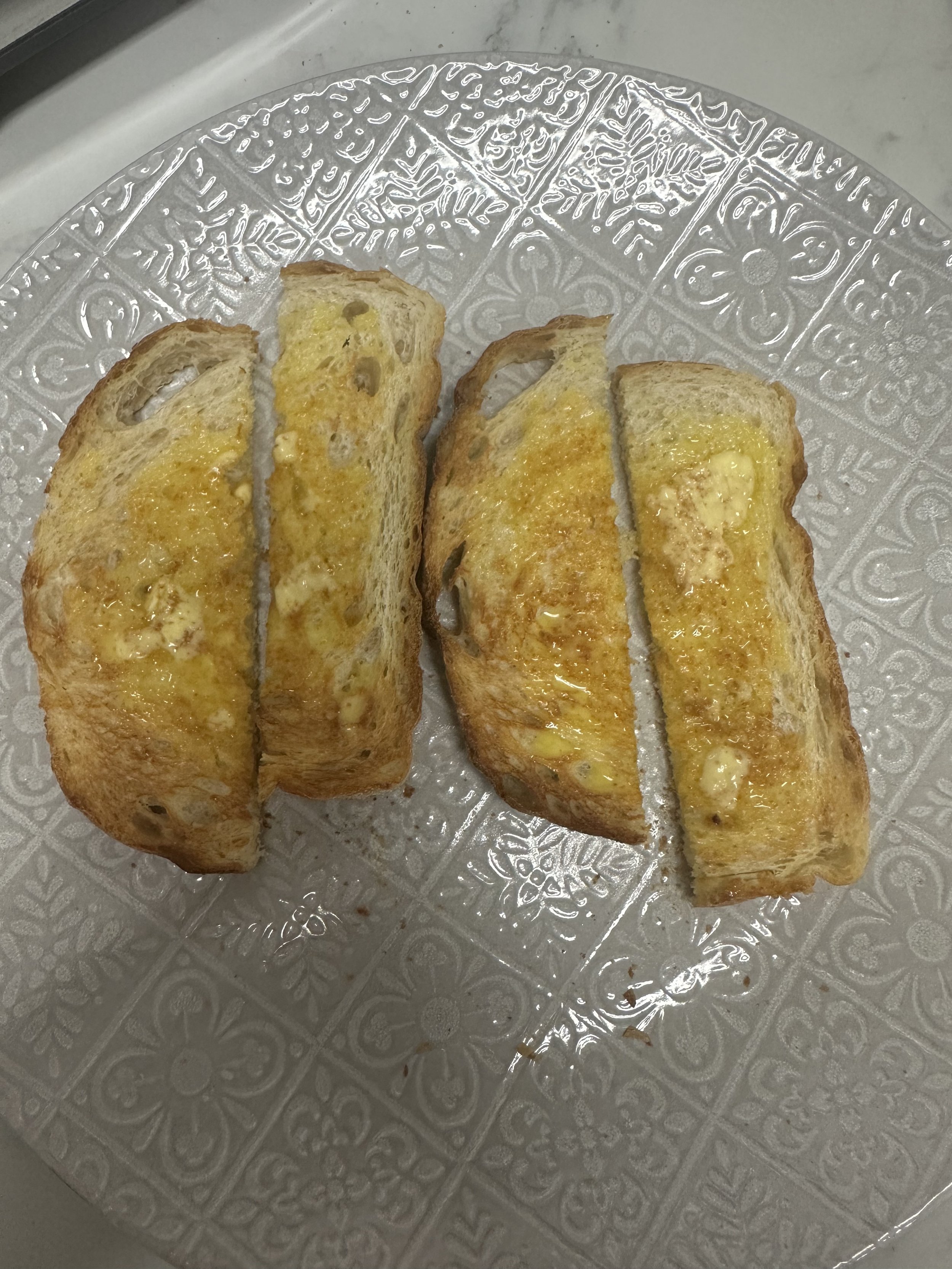
There I was at lunchtime today, standing in the kitchen with an oval sourdough loaf and a steaming cup of laksa, about to commit what I can only describe as a minor act of domestic rebellion. I was holding a knife, preparing to slice my toast the way I always do —half on the short length, somehow the "correct" way to cut bread, when something made me pause.
If I wanted this toast to actually do its job and soak up all that gorgeous coconut broth and chilli oil, I needed to cut it lengthways. Long strips that would fit perfectly into my cup and serve a purpose beyond looking "normal." Simple logic, right?
Yet here I was, knife hovering over the bread like I was defusing a bomb, having to force myself to make that lengthways cut. Because it felt wrong. It looked weird. It wasn't how toast "should" be. I was genuinely having an internal battle over bread geometry.
And that's when it hit me like a soggy piece of toast to the face: how many other completely meaningless rules am I following just because that's what I've always done? How many patterns am I unconsciously perpetuating as a mother?
This moment reminded me of something that happened when my husband did his stint as a stay-at-home dad. He whined to me one evening, sounding like he was reporting a domestic emergency, that the kids kept wanting bread for breakfast, he said it with the bewilderment of someone discovering aliens in the pantry.
I asked him what the problem was. He said, "Bread isn't a breakfast food—toast is."
I had to sit with that for a moment. "Are you seriously telling me you're making them wait while you use extra electricity and add a whole other step, with no nutritional benefit, just because you grew up with toast for breakfast and not bread?"
The silence on the other end of the phone was deafening. Here was a grown man, a perfectly intelligent human being, making breakfast unnecessarily complicated because somewhere along the way he'd absorbed the rule that bread becomes acceptable for breakfast only after it's been heated and slightly browned. As if the toaster held some sort of magical breakfast-transformation powers.
The Invisible Chains of Motherhood
This is what happens when we start to awaken as mothers, isn't it? Those moments when we suddenly see the invisible chains we've been wearing—the ones society draped around us so subtly we didn't even notice them fastening. We begin to recognise how we've been moving through motherhood on autopilot, following patterns without questioning whether they actually serve anyone.
We're all walking around with these inherited instruction manuals about how to be a "good mother." Unwritten laws about everything from how we should feel about our bodies to how we should sacrifice our own needs for our children's. Most of the time, we don't even notice them; they're just there, running in the background like some sort of maternal operating system we never consciously installed.
It's like we're all running on Motherhood 1.0 software that hasn't been updated since 1952.
But here's what breaks my heart: we don't just follow these arbitrary patterns ourselves. We pass them down to our daughters like well-meaning but toxic heirlooms, and we teach our sons that this is simply how women should be.
Gently Waking Up to Our Conditioning
My laksa toast was a tiny rebellion, but it opened something deeper. It made me see how many times I've automatically responded to my children with "that's not how we do it" when what I really meant was "that's not how I learned to do it" or "that's not what looks right to me."
The bread-versus-toast story with my husband illuminated this perfectly. Neither of us had ever questioned why bread needed to be transformed into toast to be breakfast-appropriate. We'd both inherited this rule and were unconsciously applying it, even when it created unnecessary work and complexity.
How often do we ‘correct’ our children's natural problem-solving instincts, not because their way is harmful, but because it doesn't match our inherited template of how things should look?
The bedtime performance: Why does putting kids to bed have to be this rigid demonstration of maternal competence? Story, teeth, toilet, kiss, lights out, performed with the precision of a Swiss watch every night to prove we're doing motherhood "right." But what if your child actually settles better with flexibility? What if they need to talk through their day or wiggle their body before they can rest? We've turned bedtime into maternal theatre when really, our kids just need to learn how to reset for sleep.
The "good mother" toy police: Ever caught yourself redirecting how your child plays because it doesn't look educational enough? "No, sweetheart, you don't just line up the toys—you need to be learning something." But who appointed us the Fun Police? Who decided that a child finding peace in organisation isn't valuable? We're so worried about looking like engaged mothers that we turn everything into a teachable moment. Sometimes play is just play, and that's perfectly fine.
The homework martyrdom: We've convinced ourselves that overseeing homework is the ultimate proof of our dedication as mothers. We turn it into this daily performance, getting stressed and making our kids stressed, because we've been told that good mothers are heavily involved in their children's academic success. But what if our hovering is actually creating more problems than it solves? What if stepping back serves them better?
The Awakening: What My Laksa Taught Me
That lengthways toast was more than just practical—it was an act of trusting my own judgement over inherited rules. It soaked up the broth perfectly, it was easier to handle, and honestly? It looked rather sophisticated on the plate. All because I stopped following a pointless convention that served no purpose except to make my toast look like everyone else's toast.
This is what awakening as a mother feels like: those lightbulb moments when we realise we can trust ourselves. When we stop performing motherhood according to someone else's script and start mothering from our own wisdom. It's like finally getting the user manual to our own lives.
The Real Cost of Unconscious Mothering
Here's what really gets to me: when we mindlessly follow these patterns, we're not just limiting ourselves—we're teaching our children that women should ignore their instincts in favour of social expectations. We're showing them that a mother's intuition matters less than following the rules.
Our daughters absorb this and learn to doubt themselves before they even become women. Our sons learn that mothers are rule-followers, not independent thinkers. They all learn that questioning the status quo is dangerous, even when the status quo serves nobody.
It's like we're raising a generation of people who will one day stand in their own kitchens, paralysed by the geometry of their breakfast bread.
Reclaiming Our Maternal Authority
This isn't about becoming some chaos-embracing mother who abandons all structure. It's about reclaiming our authority to make conscious choices about how we mother our children. It's about examining why we do what we do and keeping only the stuff that actually serves our families, not our fear of judgement.
Some uncomfortable questions for awakening mothers:
Which of our family rules actually help our children thrive versus making us look like good mothers?
What habits are we maintaining because we're scared of being judged if we do it differently?
Where are we shutting down our children's natural development because it doesn't fit the "good family" image?
What maternal standards are we upholding that exhaust us and help nobody?
When do we trust external expectations over our own instincts about what our children need?
The Liberation of Conscious Mothering
When we model this kind of awakened thinking for our children, we give them something revolutionary: permission to trust themselves. We show them that it's okay to question inherited wisdom, to experiment with what works, to prioritise authenticity over approval.
Children who grow up with awakened mothers become adults who can think critically about social expectations, who trust their own instincts, who don't automatically sacrifice themselves to make others comfortable.
Breaking the Generational Chain
Most of our mothering patterns come from our own mothers, who got them from theirs, generations of women trying to be "good" according to standards they never questioned. The liberating news? We can choose what to keep and what to release.
We can be the generation of mothers who stops and asks, "Actually, why do we do it this way? Does this serve my child, does this serve me, or does this serve the myth of perfect motherhood?"
We can model curiosity over conformity, authenticity over approval, consciousness over conditioning.
The Toast Test for Awakening Mothers
Next time you find yourself following a mothering pattern or enforcing a family rule, give it the laksa toast test:
Is this actually helping my child develop into their authentic self?
Would doing it differently work better for our family's actual needs?
Am I following this pattern because it serves us or because I'm afraid of being judged if I don't?
Does this come from my maternal wisdom or from inherited conditioning?
If the answer reveals conditioning over consciousness, then maybe it's time to cut your metaphorical toast a different way.
The Ripple Effect of Mother Awakening
Because here's the thing: when we wake up as mothers, we don't just free ourselves, we free our children from patterns that would have limited them for decades. We break cycles of unconscious living that could have continued for generations.
We're not raising children to fit into predetermined moulds. We're raising future adults who need to think critically, trust their instincts, and create authentic lives that work for them.
Sometimes that awakening starts with something as simple as cutting toast the "wrong" way and discovering it was exactly right for what you needed.
My laksa was absolutely perfect, by the way. And so was my lengthways toast. And so was the moment I chose function over convention, consciousness over conditioning.
That's what mother awakening looks like: small acts of rebellion that create space for our children to be fully themselves, and for us to be our whole selves. Sometimes it starts with cutting toast the "wrong" way. Sometimes it's letting them eat bread for breakfast. Sometimes it's just pausing long enough to ask: "Does this actually make sense, or am I just following the instruction manual?"
Ready to Break Your Own Generational Patterns?
What patterns are you ready to question as you awaken to conscious mothering? What inherited rules have you been following without examining whether they serve your family?
If you're nodding along thinking "I need to audit my own toast moments," I've created something just for you.
The Toast Rebellion Worksheet will help you examine your family's current patterns across key areas like bedtime, meals, and daily routines. It includes reflection questions to uncover inherited patterns from your own childhood, space to design three pattern-breaking experiments, and the complete Toast Test questions you can use anytime you catch yourself on autopilot.
Because sometimes the smallest moments of maternal rebellion create the biggest breakthroughs—for us and for the generations that follow.
Get Your Free Toast Rebellion Worksheet - Join Our Newsletter
Join thousands of awakening mothers who are choosing consciousness over conditioning. Get the worksheet plus weekly insights on conscious parenting, delivered straight to your inbox.
