

The Mother Wound: What It Is, How It Forms, and Why It Travels
The mother wound is psychological and emotional harm that forms when a mother's own unhealed trauma shapes the way she relates to her children, usually without her awareness. It is not caused by cruelty but by unsupported maternal transitions that calcify over years into fixed patterns of control, emotional unavailability and self-justification. The wound travels generationally until someone in the lineage chooses to interrupt it. This article explores how it forms, why mothers are often entirely unaware of the harm they cause, and what the healing actually requires.
There is a woman most people don't talk about. She's not the mother in the Hallmark film, and she's not the monster in a true crime podcast. She sits somewhere in between: unremarkable from the outside, increasingly corrosive from within. She might be your neighbour, your client, or your friend's mum. She might, quietly and painfully, be your own mother.
She didn't start out aiming to damage anyone.
That's the part we need to sit with before we go any further. Because the instinct, especially for those of us who've been on the receiving end of a mother like this, is to reach for blame. To land on a story that makes sense of the harm. And yet blame, while satisfying in the short term, leaves the actual mechanism untouched. It doesn't explain how a woman gets there. And without understanding how, we cannot change what keeps happening.
So let's talk about how.
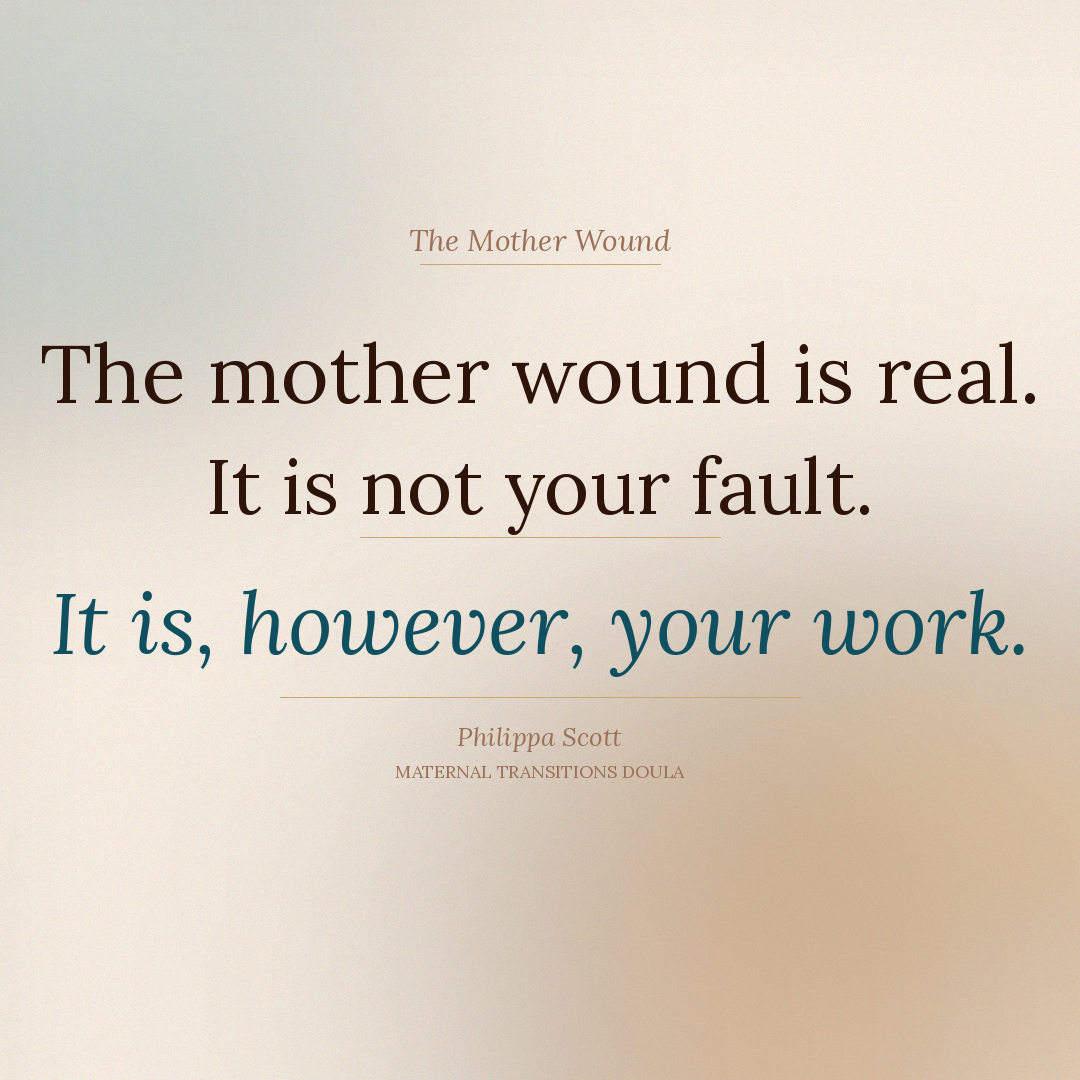
The Mother Wound Is Real
The Cycle She Was Never Told About
Motherhood is a series of transitions, not a single one. This is the idea that sits at the centre of my work: that every time a woman enters a new chapter of motherhood, a genuine developmental process begins, an initiation. Her nervous system begins to reorganise. Her identity stretches and shifts. Old patterns that were sitting quietly in the background start to surface. And without support, without language, without anyone naming what is happening to her, she begins to carry all of that alone.
I call this The Mother Awakening Cycle.
It moves through six recognisable phases: Initiation, Accommodation, Fragmentation, Awakening, Reclamation, and Integration. The cycle doesn't happen once. It repeats, sometimes every few years, each time motherhood asks something new of her. A new baby. A toddler who unlocks something primal. A school-age child who begins pushing back. An adolescent who mirrors her most unresolved self directly back at her. Perimenopause arriving like an uninvited guest who refuses to leave until she's finally dealt with the things she's been putting off for two decades.
Each cycle offers the same invitation: grow, or calcify.
When a mother moves through these cycles with adequate support, internal resources, nervous system regulation, relationships that hold her, and the language to understand what's happening, she deepens. Motherhood becomes a site of genuine transformation. She becomes, in the truest sense, a Family Architect: someone who consciously shapes the emotional landscape in which her children grow up.
But when she doesn't have those things?
When the cycle arrives, and there is no one to hold her through it?
This is where it gets difficult. And important.

The Mother Awakening Cycle
What an Unsupported Transition Actually Looks Like
Let's trace it. Not as an abstract concept, but as a real woman moving through real time.
At Initiation, she crosses the threshold. Maybe it's birth. Maybe it's adoption, or step-parenting, or a child's diagnosis that rewrites everything. Her nervous system is in genuine upheaval. Her identity is shifting in ways she doesn't have words for. The culture around her hands her a checklist, feeding schedules, sleep strategies, milestone charts, and treats the entire experience as logistical. You'll be fine. All mothers go through this. It gets easier.
She gets no acknowledgement that she, not just the baby, has just undergone a profound initiation. She is expected to cope. And mostly, she does. She is, after all, a resourceful woman.
At Accommodation, the real grind begins. The invisible load builds. She accommodates. She stretches to meet the demands of her children, her partner, her family's expectations, her own internal standards about what a good mother looks like. She gets very good at managing. She gets very good at not needing.
She starts to lose herself so gradually that she doesn't notice it happening. She's too busy keeping everything running. The loss of self gets reclassified as just how it is when you're a mother. It becomes normalised, even virtuous.
At Fragmentation, the weight of years of accommodation finally breaks the surface. She begins to snap at her children in ways that scare her. She cries in the car. She feels chronically depleted and quietly furious in a way she can't quite explain or justify. Old trauma patterns, the ones that were sitting quietly for years, begin to activate. They show up in her parenting. She reacts before she thinks. She says things she doesn't mean. She apologises. She tries harder. She fragments further.
Here is the critical junction.
The Awakening is available to her at this point. It is the moment where something inside her recognises that this isn't simply exhaustion or failure. It's something deeper. A developmental shift that is asking her to evolve. To look at herself. To do the work her own mother probably never did.
But if the Awakening isn't supported, if she has no framework, no guide, no community that names what's happening, two paths open up. She either bypasses the Awakening entirely, doubling down on coping strategies that have long since stopped working. Or she reaches some version of it but has no pathway into Reclamation and Integration.
Either way, she stays stuck.
And she stays stuck for years. Sometimes for decades.
The Decades-Long Road to the Mother Wound
Here is what I have observed, in my work, in the research I've studied, and in my own life with painful intimacy, about what happens when a woman cycles through these transitions without sufficient support, again and again, for ten, fifteen, twenty+ years.
The resentment that began in Fragmentation doesn't resolve. It calcifies. It becomes a fixed orientation toward the world, and increasingly toward the people closest to her, because closeness is threatening when you've never learned to be safely held. Her children, who need her presence most, also represent her greatest unmet need: the need to have been truly seen herself, as a child, as a new mother, as a woman in transition.
She begins to relate to her children not as a regulated adult who is responsible for their emotional safety, but from the place of her own unmet child-self. The love is real, well, it usually is. But the love becomes entangled with need, with control, with the unconscious demand that they make her feel worthy, or stable, or valued. Demands that no child can or should ever meet.
This is when the relationship begins to corrode.
But here is what makes this particular story so heartbreaking, and so resistant to easy resolution: she doesn't know she's doing it.
I want to say that again, because it tends to provoke a strong reaction in the daughters and sons who've lived it. She is not pretending. She is not wilfully blind in the way we use that phrase when we suspect someone is choosing ignorance. The obliviousness is not a performance. It is a structural feature of what happens when the Awakening never arrives or is repeatedly unsupported.
The Awakening phase of the cycle requires something specific: the capacity to turn and look at yourself clearly. To witness your own patterns, your own impact, your own contribution to the dynamic. That capacity is built slowly, and it requires a regulated enough nervous system to tolerate what you see when you look. It requires someone, or something, to have held up a mirror gently enough that you didn't have to shatter in order to see your own reflection.
If that never happened, if every transition was bypassed, every Fragmentation was followed by more Accommodation rather than Awakening, every signal from the nervous system was suppressed or redirected outward, then the self-witnessing capacity simply doesn't develop. It atrophies like a muscle that was never used.
What grows in its place is a fortress of self-justification.
Not cynically. Not consciously. But steadily, over the years, the pain had to go somewhere. Every grievance becomes evidence that she was wronged. Every boundary her children eventually set becomes proof that they are ungrateful, difficult, or too sensitive. Every attempt to name the impact of her behaviour becomes an attack on her character, a betrayal, an act of cruelty directed at a woman who gave everything.
She is, from her own internal vantage point, the reasonable one. Frequently, the only reasonable one. Her version of events is fully coherent, internally consistent, and almost entirely impervious to new information.
This is why her adult children, particularly those who have done their own work, who have come to understand what happened to them, who have very clear memories and very legitimate feelings, will often find it close to impossible to reach her. You cannot logic someone into self-awareness when self-awareness is the very thing the wound prevents. You cannot have a productive conversation about impact with someone whose nervous system experiences accountability as an existential threat.
And so the estrangements happen. The relationships with grandchildren that never fully form, or that collapse under the weight of accumulated harm. The adult children who make excuses to miss Christmas, then quietly stop making excuses at all. The increasing bewilderment on her part as her world contracts, because from where she stands, she has done nothing wrong, and the people she loves keep leaving.
The tragedy deepens: she will often recruit others into her version of events. Friends, other family members, and well-meaning people who only see one side. She tells her story fluently and with genuine feeling, because it is, for her, true. She is not lying. She is faithfully reporting her experience, and it has been curated over decades of unconscious self-protection into a narrative in which she is always, at the centre, a person who tried very hard and was not sufficiently loved in return.
The children she harmed know a different truth. And they carry the particular exhaustion of knowing something deeply, being unable to be witnessed in it by the one person who most needs to understand it, and watching that person, sometimes publicly, present herself as the wounded party.
The Gap Between Her Reality and Theirs
One of the most painful features of the mother wound, for those who carry it, is this gap. Not the harm itself, necessarily, but the impossibility of shared reality with the person who caused it.
Most relational wounds, over time, have some potential for a shared narrative. Some possibility of yes, that happened, I see how that hurt you, I'm sorry. Even if it's imperfect and partial, that acknowledgement is what allows the wound to close, or at least scar over cleanly.
The mother who never moved through the Awakenings cannot offer that. It is not that she won't. She genuinely cannot. Her nervous system has spent decades protecting her from precisely this reckoning. The architecture of her self-concept depends on not seeing what her children see. To truly acknowledge the harm would require dismantling a story she has built her entire sense of survival around.
So the adult children are left holding a truth that nobody in the family system is allowed to name. Often, they second-guess themselves. Her certainty is so absolute, her account of events so detailed and emotionally convincing, that her children can spend years wondering if they are the problem. If they are, as she frequently suggests, too sensitive. Too much. Too ungrateful for everything she did.
This is the wound working exactly as it was designed to, not by her conscious intention, but by the logic of unprocessed pain seeking company. Unwitnessed pain that can't find resolution in the self will reach outward, unconsciously, to make sure it isn't alone.
She Didn't Begin There
My own mother is estranged from most of her grandchildren, and her children are in some form or another disengaged from her. I say this not as an indictment of her but as a data point that I have had to hold very carefully over many years of my own therapeutic and regulatory work.
She was, once, simply a woman who became a mother without being supported through the transitions motherhood initiates. She moved through Initiations that were treated as events rather than thresholds. She Accommodated for so long that she lost contact with her own nervous system and her own identity. She Fragmented, visibly and repeatedly, and received no language for it. The Awakening available to her never came in the form of growth. It came instead as hardened certainty: that she knew best, that she had been failed by others, that she was owed more than she received.
From that vantage point, she has been entirely consistent. She has never, to my knowledge, doubted the rightness of her own perspective. That consistency is not a strength. It is the signature of a nervous system that found an impenetrable position and stayed there because moving felt unsurvivable.
Does she know the harm she has caused? In the way most people mean that question: no. She does not. She believes herself to be a loving, reasonable, fundamentally good mother who has been misunderstood and, in some cases, betrayed. That belief is not a lie she tells others. It is the story her entire psychological structure depends upon.
This is not a defence of the harm. It explains the mechanism. And the explanation matters, not because it changes what happened, but because without it, we are left only with blame. And blame, while emotionally satisfying, does nothing to prevent the next generation of mothers from walking the same road.
What Supported Transitions Actually Require
So what are those conditions? What does adequate support at each phase of the Mother Awakening Cycle actually look like?
It requires, first, a nervous system that has access to regulation, not perfect regulation, but enough that a woman can tolerate the discomfort of transition without collapsing or catastrophising. This is the baseline. Without it, no amount of information or insight makes a meaningful difference. The nervous system has to be in a state where it can receive and integrate new experience, and for many mothers this is not a given. Years of Accommodation and Fragmentation leave the system chronically dysregulated. The healing has to begin there.
It requires language. The moment a woman hears the shape of her experience reflected back to her, this is Fragmentation, not failure; this is what it means that you can't stop snapping at your children; this is what your nervous system is trying to tell you, something shifts. Not everything, but something important. The shame releases slightly. The self-blame eases enough to create a gap, and in that gap something like curiosity becomes possible. This is the beginning of the Awakening. This is where the self-witnessing capacity begins to develop.
It requires community. Not the kind that performs wellness on social media. The kind that witnesses. The kind where a woman can say I screamed at my children, and I don't know who I am anymore and be met not with horror or advice but with recognition. Because the isolation of unsupported motherhood is, in itself, a wound. We were never meant to do this alone, and we are doing it more alone than any generation before us.
And it requires, crucially, that the cultural conversation about motherhood widen enough to include this. To include the reality that a woman who becomes harmful to her children was almost always a child who was harmed herself, and a mother who was unsupported in her own transitions. To hold the complexity of that without either absolving or condemning. To ask: what would have changed the trajectory?
Because the answer to that question isn't punitive, and it isn't naive. It is structural. It is about building the right conditions: the language, the nervous system support, the relational witnessing that make the Awakening possible before the calcification sets in. Before the self-justification fortress becomes the only place she knows how to live.
Why This Matters for All of Us
The mother wound does not stay in one family. That is its nature. It travels forward, into the nervous systems of children who grow up learning that love is conditional, that their needs are burdensome, that closeness is unsafe. Some of those children become parents themselves and work desperately to break the pattern, often succeeding with tremendous effort and tremendous grief. Others carry the wound forward, unsupported, and the cycle continues.
And the cycle is perpetuated, in part, because the women at the centre of it genuinely don't see it. They don't wake up and decide to harm. They don't lie awake cataloguing their damage to others. They have arrived, gradually, over years of unprocessed transition, at a version of reality in which they are simply a person trying their best in a world that has not always appreciated them.
That is the most important thing I can say about this: the harmfulness and the obliviousness are not separate phenomena. They are two expressions of the same unhealed wound. The woman who cannot see what she is doing is the same woman who was never supported through her own Fragmentation, who never made it to Awakening, who never had anyone hold up a gentle mirror and say what you're carrying is real, and you don't have to keep carrying it the same way.
We are not talking about rare and extreme cases. We are talking about the ordinary, quiet tragedy of motherhood as it is currently lived: without adequate language, without adequate community, without a cultural understanding that the woman who becomes a mother is herself undergoing something profound and repeated and in need of active support.
The mothers who end up hurting their children, and by hurt I mean not only the dramatic forms of harm, but the chronic emotional unavailability, the control, the volatility, the resentment that children absorb like a second skin, those mothers almost universally started somewhere I recognise. They started at Initiation, without support. They moved through Accommodation, without anyone seeing them. They arrived at Fragmentation and were handed shame instead of a map.
The map was always available. Nobody gave it to them.
That is what I am trying to change.
This is part of a wider body of work on Maternal Transition: the psychological, nervous system and identity shifts that motherhood initiates across a woman's life. If you recognise yourself in any part of this, as a daughter who carries the wound, or as a mother who is somewhere inside an unsupported cycle, the work of reclamation is not only possible but available to you.
The cycle doesn't have to end in calcification.
It can end in integration.
It nearly always can, with the right support at the right time.
I’ve got you,
Philippa Scott
Maternal Transtions Doula
Q: What is the mother wound?
The mother wound is the psychological and emotional harm passed from a mother to her children when her own unhealed trauma, unsupported transitions and unprocessed pain shape the way she shows up in her relationships. It is not usually caused by deliberate cruelty. It is most often the result of a woman who moved through the transitions of motherhood without adequate support, language or nervous system regulation.
Q: Why do mothers become toxic or emotionally harmful over time?
Most mothers who become emotionally harmful to their children do not begin that way. The process typically unfolds over a decade or more as unprocessed pain calcifies into fixed patterns of self-justification, control and emotional unavailability. When a mother moves through the major transitions of motherhood without support, her unresolved pain has nowhere to go. Over time, it shapes how she sees herself, her children and her relationships, often in ways she is entirely unaware of.
Q: Does a mother who causes a mother wound know she is doing it?
In most cases, no. Obliviousness is not a performance, it is a structural feature of what happens when a woman never moves through the Awakening phase of maternal transition. Without the capacity for self-witnessing that this phase builds, she cannot see her own impact. Her version of events is genuinely held, internally consistent, and largely impervious to challenge from her children.
Q: Is the mother wound my fault?
No. The mother wound is not the fault of the child who carries it. It originates in the unhealed experiences and unsupported transitions of the mother, and often in her mother before her. However, once you are aware of the wound, the healing becomes your responsibility, not because you caused it, but because you are the one who can choose to interrupt the cycle.
Q: What is maternal transition?
Maternal transition refers to the ongoing psychological, nervous system and identity shifts that occur when a woman becomes and evolves as a mother. Unlike the traditional view of motherhood as a single life event, maternal transition recognises that motherhood initiates a lifelong cycle of developmental change, moving through phases of initiation, accommodation, fragmentation, awakening, reclamation and integration.
Q: What is The Mother Awakening Cycle?
The Mother Awakening Cycle is a developmental framework created by Philippa Scott, Maternal Transitions Doula and founder of Fantastic Futures Coaching. It describes the six recurring phases of maternal transition — Initiation, Accommodation, Fragmentation, Awakening, Reclamation and Integration — that mothers move through each time motherhood asks something new of them. The cycle repeats across a woman's life and can either deepen her or calcify her, depending on the support available at each phase.
Stay in the loop and get updates
