

Touched Out Is Not a Self-Care Problem. Here's What It Actually Is.
Being touched out describes a state of sensory and nervous system overload in which physical contact feels overwhelming, irritating or difficult to tolerate. Mothers may experience this when the sensory demands of caregiving exceed their nervous system's current capacity to process additional stimulation. Accumulated stress, birth trauma, childhood adversity, anxiety and previous experiences involving physical autonomy can influence a person's response to touch. Rest and time alone may provide temporary relief, while persistent or severe touch aversion may benefit from exploring the underlying nervous system and trauma responses contributing to the experience.
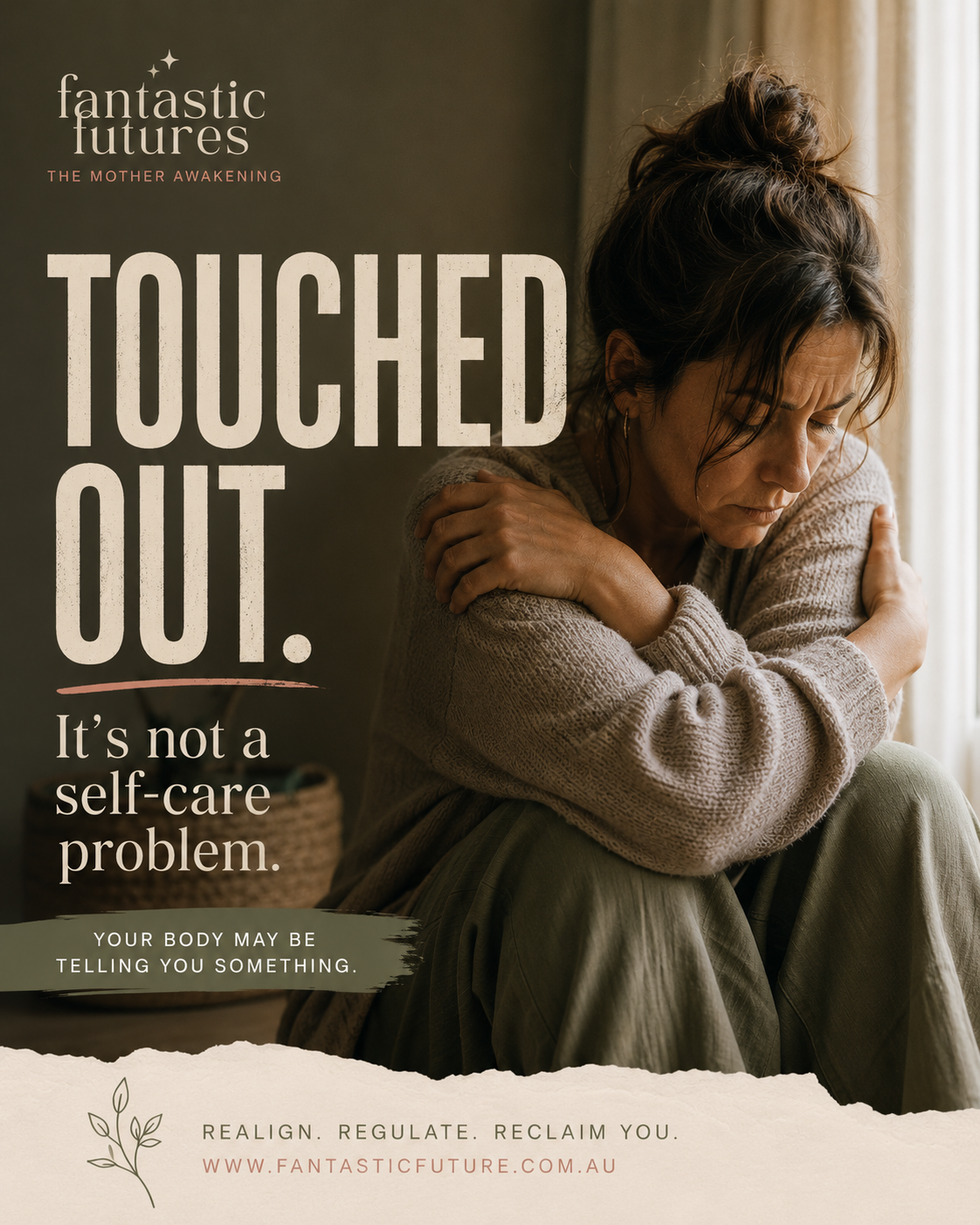
Overwhelmed mother sitting alone with her arms wrapped around herself, representing sensory overload, touch aversion and the nervous system experience of feeling touched out in motherhood.
If you have been touched out, you will know exactly what the phrase describes. The feeling of your skin belonging to too many people. The way your body recoils from one more hand reaching for you, one more small person climbing across you, your partner's entirely innocent hand on your shoulder that lands like a demand you have nothing left to meet.
The cultural response to this experience is remarkably consistent. Have a bath. Get some alone time. Ask for help. Practice self-care.
These are not bad suggestions. They are also not addressing what is actually happening.
The Somatic Reality of Being Touched Out
Being touched out is a nervous system state, not a scheduling problem. It is your body registering a level of sensory activation that exceeds its current capacity to process. And while rest and solitude can temporarily reduce that activation, they do not address the underlying capacity question.
Some mothers move through the early years of physical caregiving without reaching this threshold, or recover quickly when they do. Others find that they are touched out constantly, severely, and in ways that feel disproportionate to the actual situation.
The difference between these two groups often has nothing to do with how much they are being touched. It has to do with how much their nervous system is already carrying before a hand reaches for them.
You are not touched out from today. You are touched out from everything today landed on top of.
A nervous system that is running on stored activation, whether from a difficult birth experience, from childhood adversity, from accumulated stress and emotional suppression, has less capacity before it hits its limit. The physical care demands of motherhood, which are significant and unrelenting, tip it over far more quickly.
The bath will help you tonight. It will not change what tomorrow feels like.
What being touched out may actually mean
Being touched out can happen when the sensory demands placed on your body exceed your nervous system's current capacity to process more stimulation. For some mothers, the threshold is already lowered by accumulated stress, difficult birth experiences or earlier experiences involving touch and physical autonomy. This can mean that today's touch is landing on a nervous system that was already carrying significant activation.
What Nobody Told You About Touch and Trauma
Birth experiences leave physical imprints. Many mothers carry unresolved birth trauma in their bodies without a label for it. They know something about the experience felt wrong, or overwhelming, or frightening. What they may not know is that unresolved birth trauma can significantly affect the nervous system's relationship to physical sensation and proximity.
Similarly, if physical affection in your own childhood was complicated, conditional, absent, or associated with anxiety, your body may have a learned response to being touched that has nothing to do with the people who are touching you now. Your children are not doing anything wrong. Your nervous system is responding to a much older story.
This is also true for mothers who experienced sexual trauma, chronic anxiety, or environments where their physical autonomy was routinely overridden. The body keeps score. And when it is scoring, the data from twenty years ago weighs exactly the same as the data from this morning.
The Conversation the Wellness Industry Is Not Having
The maternal wellness space has created an enormous infrastructure around the idea that mothers need rest, boundaries, self-care, and to ask for more help. This is not wrong. But it addresses the downstream experience without touching the upstream cause.
If your nervous system has a stored trauma response connected to physical sensation, proximity, or being needed, self-care will not resolve it. What resolves it is working directly with that stored response at the somatic level. Not talking about it indefinitely. Actually processing it, so the body's reaction changes.
You deserve more than management strategies for a body that has been trying to tell you something for years.
Touched out is your body communicating. The message is not that you need a better bedtime routine or a more supportive partner, though both of those things have their place. The message is that something in your nervous system has been carrying more than it should have to, for longer than it should have had to.
That is resolvable. Not in years. In sessions.
You are not broken. You are not ungrateful. You are not a bad mother for flinching when your child reaches for you. You are a woman whose body is asking, quite loudly, for something more than a bubble bath.
To understand what your nervous system is carrying and book an Alignment Call or take the Wired quiz.
FAQ section
What does being touched out mean?
Being touched out is a common phrase used to describe feeling overwhelmed, irritated or physically uncomfortable with further touch after prolonged physical contact or sensory demands. It is frequently experienced by mothers and primary caregivers.
Why am I so touched out as a mum?
The physical demands of caregiving can create significant sensory load. If your nervous system is already carrying stress or heightened activation, you may reach your sensory capacity more quickly.
Why don't I want my partner to touch me after having children?
After spending much of the day physically needed by children, additional touch can feel like another demand on an already overloaded nervous system. Birth experiences, stress, hormonal changes, relationship factors and previous experiences with touch can also contribute.
Can birth trauma make you feel touched out?
A difficult or traumatic birth experience may affect a person's nervous system response to physical sensation, proximity or loss of physical autonomy. For some mothers, unresolved birth trauma may contribute to heightened sensitivity around touch.
Does being touched out mean I don't love my children?
No. Feeling overwhelmed by physical contact does not measure the love or attachment you have for your children. It describes your current sensory and nervous system capacity.
How do I stop feeling touched out?
Reducing sensory input, creating periods of physical space and sharing caregiving demands may help. If the experience is persistent, intense or connected to previous trauma, exploring the underlying nervous system response with an appropriately trained practitioner may also be helpful.
